There’s a procurement problem that comes up more often than most buyers want to admit: pipe arrives labeled as seamless, the paperwork says seamless, the price reflected the seamless premium — and what’s actually in the bundle is ERW or LSAW welded pipe that someone decided to pass off as seamless. It happens at different scales, from outright substitution to honest documentation errors, but the consequence is the same. You have pipe that doesn’t meet the specification you paid for, installed in an application that required seamless for a reason.
The good news is that welded pipe and seamless pipe have physical differences that are detectable without laboratory equipment. Most of the checks can be done at the receiving dock with tools you already have.
Why the Distinction Matters Enough to Verify
Seamless pipe is formed by piercing a solid billet and rolling it into a tube. There’s no seam anywhere along the length. Welded pipe starts as flat strip or plate that’s formed into a tube shape and joined along one longitudinal seam using ERW, LSAW, or DSAW processes.
The seam isn’t just cosmetic. In applications involving cyclic pressure, high temperature, or corrosive media, the seam area has different mechanical properties from the base material — the heat-affected zone created by welding behaves differently under load. It’s also a potential weak point for corrosion in certain chemical environments. That’s why piping system codes specify seamless pipe for certain pressure and temperature ratings. If you’re using welded pipe in those applications, you’re outside the design specification regardless of what the shipping documentation says.
The Visual Check
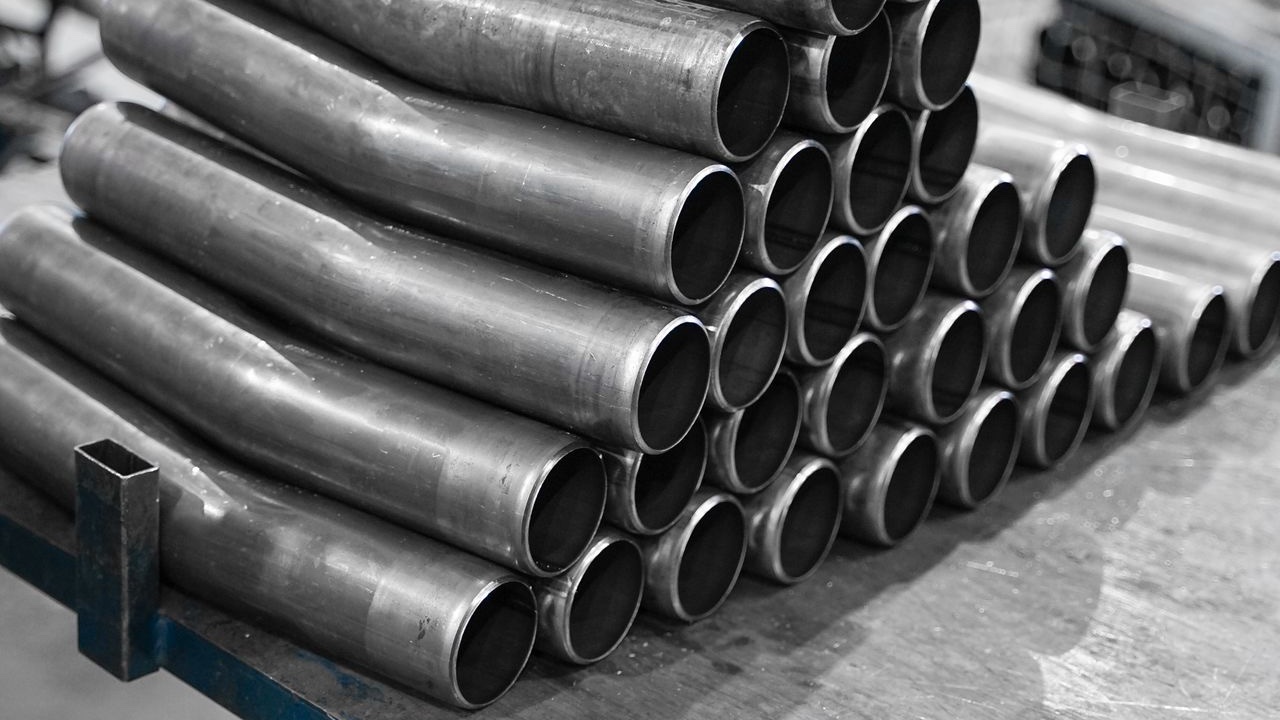
The most direct way to distinguish seamless from ERW welded pipe is to look at the pipe bore — the interior surface — at each end.
ERW pipe has a visible longitudinal weld bead on the inside surface. On the outside, the seam is usually ground flush and may be almost invisible, but the internal bead is harder to remove completely. In smaller diameters, you can see it by looking through the pipe with a flashlight. In larger diameters, a hand mirror and a torch does the job. The bead runs straight along the length of the pipe, parallel to the axis.
LSAW and DSAW pipe is usually large-diameter (16 inches and up) and the weld seam is more obvious — the outside seam is visible as a continuous line along the pipe length, and the inside may be dressed but the seam line is still visible.
Seamless pipe has no longitudinal line anywhere on the interior or exterior surface. The bore looks uniform all the way around. There may be manufacturing marks — surface irregularities from the rolling process — but no straight longitudinal seam.
Check multiple pieces from the bundle, not just one. Substitution sometimes involves mixing welded and seamless material in the same bundle.
Wall Thickness Uniformity
Seamless pipe is pierced and rolled from a solid billet. The process produces some variation in wall thickness around the circumference — it’s inherent to the manufacturing method. The wall is never perfectly uniform.
ERW pipe is formed from strip steel, which starts at a uniform thickness. The finished wall thickness is more consistent around the circumference than seamless.
This is counterintuitive — you might expect more consistent wall thickness to be a sign of better quality. But for verification purposes, if you’re measuring wall thickness at multiple points around the pipe cross-section and getting nearly identical readings, that’s a characteristic of welded pipe, not seamless. A proper seamless pipe will show some variation between the thickest and thinnest points — typically within the ASTM tolerance, but measurable.
Use an ultrasonic thickness gauge at several points around the circumference: 12 o’clock, 3, 6, and 9. Do this near each pipe end and at mid-length. If the readings are nearly identical at every point, be skeptical.
Pipe End Examination
Look at the cut end of the pipe under a bright light or with a magnifying glass. In ERW pipe, if the seam was ground on the exterior but not fully removed, you can sometimes see the transition between the weld zone and the base material at the pipe end — a slightly different surface finish or color in a narrow band.
On the bore side of the cut end, look for any surface irregularity that runs in a line. The weld bead in ERW pipe sometimes shows as a slightly raised or differently-colored line at the bore edge of the cut end.
Seamless pipe ends typically show a consistent cut surface with no linear features parallel to the pipe axis.
Documentation Cross-Check
Compare the mill test report heat numbers to the pipe markings. Every piece of pipe should have the heat number stenciled or stamped on it. The heat number on the pipe should appear in the MTR package. If the pipe carries a heat number that isn’t in the documentation, or if the documentation references a heat number that doesn’t appear on the pipe, something in the chain of custody has broken down.
Check whether the MTR references the correct material specification. For carbon steel seamless pipe, the relevant ASTM specifications are A106 (high-temperature service), A53 Type S (general service), or A333 (low-temperature). For stainless, A312. If the MTR references A53 Type E or another welded-pipe specification, that’s not a seamless pipe MTR regardless of what the label says.
When to Use Third-Party Inspection
For large orders or applications where the consequences of receiving incorrect pipe are significant, visual inspection at the receiving dock is a first check, not a complete verification. Ultrasonic testing can detect the weld seam in ERW pipe that’s otherwise been well-finished. Radiographic testing will show the seam if UT doesn’t. These methods require a qualified inspector and appropriate equipment, but they’re definitive.
Working with a Seamless Pipe Manufacturer who provides full traceability — heat-linked MTRs, clearly marked pipe, and the ability to answer detailed questions about their process — reduces the likelihood of this problem arising in the first place. A manufacturer who can’t tell you which mill produced the pipe or which specification their MTR refers to is a supplier where verification at receiving becomes essential rather than optional.
The checks described here take time. For a shipment where substitution would be expensive or dangerous, that time is worth spending before the pipe goes into the system rather than after.